Midnight Money Pit: Why Your Sportsbook App Is Widest Open When Your Eyes Are Barely Open

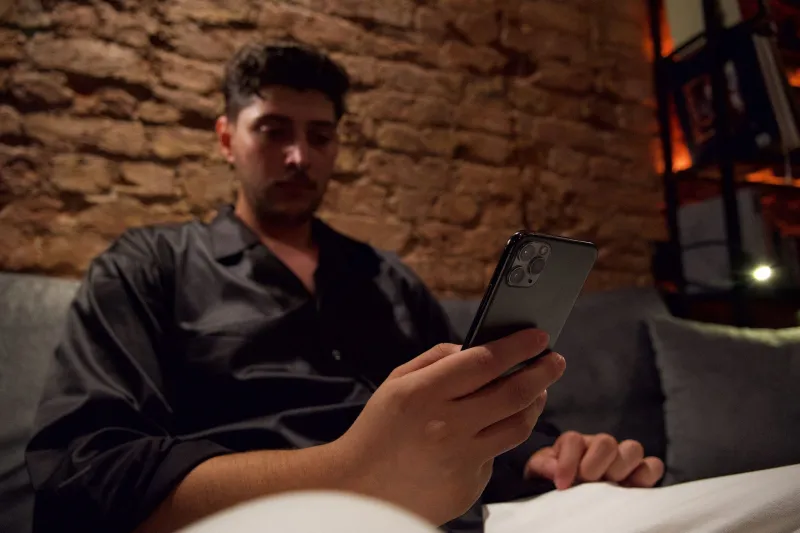
There's a specific kind of silence that settles into a living room around 2 AM. The TV is still on, casting that pale blue glow across a face that absolutely should be horizontal on a pillow right now. The last NBA game ended an hour ago. The dog gave up on you at midnight. And yet, somehow, the sportsbook app is open, the thumb is scrolling, and a man who works a real job in six hours is seriously considering a live bet on a Chilean soccer match he has never heard of.
This is not a rare edge case. This is Tuesday.
The late-night chase is one of the most well-documented, least-discussed disasters in recreational gambling. Everyone talks about the bad beat. Everyone eulogizes the seven-leg parlay that died on a backdoor cover. But nobody wants to sit down and honestly examine what happens in those final two hours before sleep, when fatigue and available account balance combine into something genuinely catastrophic.
The Neurological Case Against Betting After Midnight
Here's the part where we briefly pretend to be responsible adults before immediately undermining ourselves.
Sleep deprivation doesn't just make you tired. It specifically degrades the prefrontal cortex — the exact region of the brain responsible for impulse control, risk assessment, and the ability to recognize when something is a terrible idea. Studies have shown that even moderate sleep restriction produces decision-making deficits comparable to mild intoxication. Which means the guy betting the 2 AM Taiwanese baseball over is, neurologically speaking, roughly equivalent to the guy who had three beers at happy hour.
Except the guy at happy hour usually stops at three beers.
Fatigue also creates what researchers call "present bias" on steroids — an already-terrible tendency to overweight immediate outcomes while completely ignoring longer-term consequences. At 2 AM, the only thing that feels real is the $47 sitting in your account and the burning injustice of that third-quarter fumble that cost you everything. Tomorrow's rent? Abstract. Tonight's KBO game? Extremely concrete and somehow very solvable.
How Sportsbooks Engineer the Late-Night Window
It would be comforting to believe that the sportsbooks are simply passive beneficiaries of your poor sleep hygiene. They are not.
The overnight sports menu is a masterpiece of deliberate obscurity. By 11 PM Eastern, the major American markets have largely gone quiet. What fills the void is a rotating carousel of international leagues — Australian Rules Football, European basketball second divisions, South American soccer, Asian baseball — specifically chosen because the average American bettor has approximately zero contextual knowledge about any of them. You don't know the team form. You don't know the travel schedule. You don't know if the star player is nursing a hamstring. You are betting on vibes and a Wikipedia-level understanding of the sport's basic rules.
The books know this. The lines on overnight international markets are not sharp. They don't need to be. The juice is slightly wider, the limits are lower (protecting the book from the rare person who actually does their homework), and the target demographic is someone who is exhausted, emotionally compromised, and looking for action rather than value. The product is specifically calibrated for the state you're already in.
Live betting makes this exponentially worse. The late-night live markets update fast enough to feel like skill is involved — you're reacting, reading momentum, making real-time calls. What you're actually doing is pattern-matching on random variance while a server somewhere automatically adjusts lines faster than your sleep-deprived brain can process them. The house wins this game every single time. You are not the exception.
The Anatomy of a Midnight Meltdown
Let's walk through the standard progression, because recognizing the pattern is the first step toward absolutely continuing to do it anyway.
Phase One: The Reasonable Wind-Down. You're up $80 on the day. Good session. You tell yourself you'll just check the overnight lines for a second. One glance. You're not going to bet anything.
Phase Two: The Hedge Rationalization. You find a game that "makes sense." It's not chasing, you tell yourself. It's a separate, independent opportunity that happens to be available right now. You put $30 on it. You're still up $50 if it loses. That's fine.
Phase Three: The Correction. It loses. You're now up $50 on the day, which feels exactly like being down $30 from where you were twenty minutes ago. The math is technically the same but the emotional calculus is completely different.
Phase Four: The Spiral. The next bet is slightly larger. The justification is slightly flimsier. The sport is slightly more obscure. The clock now reads 2:15 AM and you are researching the home/away splits for a Finnish ice hockey team using a website that hasn't been updated since 2019.
Phase Five: The Commitment. At some point in the spiral, you stop trying to get back to your earlier peak and simply try to get back to even. This is the most dangerous psychological shift in all of gambling. Getting back to even is not a strategy. It is a feeling. And feelings don't cover spreads.
The $47 Problem
There's a specific account balance that deserves its own section: the awkward leftover. Whatever amount remains in your account after the night's main action — $47, $63, $112 — this number is extraordinarily dangerous precisely because it feels disposable.
If you had $500 in your account, you might exercise some restraint. But $47? That's basically nothing. You can't do anything useful with $47. Might as well put it on something. This logic is how $47 becomes $0, and how $0 becomes a deposit, and how a deposit at 2 AM becomes a conversation you don't want to have with yourself in the morning.
The sportsbook does not think $47 is basically nothing. The sportsbook thinks $47 is $47.
An Honest Prescription Nobody Will Follow
The correct move — and we say this with full awareness that you will not do it — is to set a hard stop time. Not a dollar-amount stop loss, because those are infinitely negotiable at midnight. A time. Eleven PM, the app goes dark. Whatever you've won or lost is the final score. The overnight markets will be there tomorrow night, and you'll still have zero idea what's happening in the Chilean Primera División.
Alternatively, you could simply recognize that the 2 AM version of yourself is a different, significantly worse bettor than the 7 PM version, and treat his decisions accordingly. Would you take betting advice from a guy who hasn't slept, just lost on a backdoor cover, and is now emotionally invested in a sport he learned about four minutes ago? Of course not. That guy is an idiot.
That guy is you, but later.
The late-night chase doesn't feel like gambling at its worst. It feels like grinding, like persistence, like refusing to accept a bad day's verdict. That's what makes it so effective at emptying accounts. The sportsbook stays open all night for a reason. The reason is not that they enjoy your company.