Overturned and Underwater: How Replay Review Became the Grim Reaper of Same-Game Parlays
It happens in a specific order, and if you've been betting long enough, you know every brutal step by heart.
First, the catch. Clean, obvious, undeniable — receiver drags both feet, secures the ball, turns upfield. Your same-game parlay, which was one leg away from paying out $340, just locked in. You're already doing the math on what you're ordering from DoorDash. Then the broadcast cuts to a red flag sailing onto the field. Then the dreaded words appear on screen: Under Review. Then the slow-motion replay comes in from seventeen different angles, each one somehow making the call look less certain than the last. Then the referee walks to the hood, stares into the void for ninety seconds, and comes out to announce that the ruling on the field has been reversed.
Your parlay is dead. Your DoorDash order is canceled. Your Sunday is over.
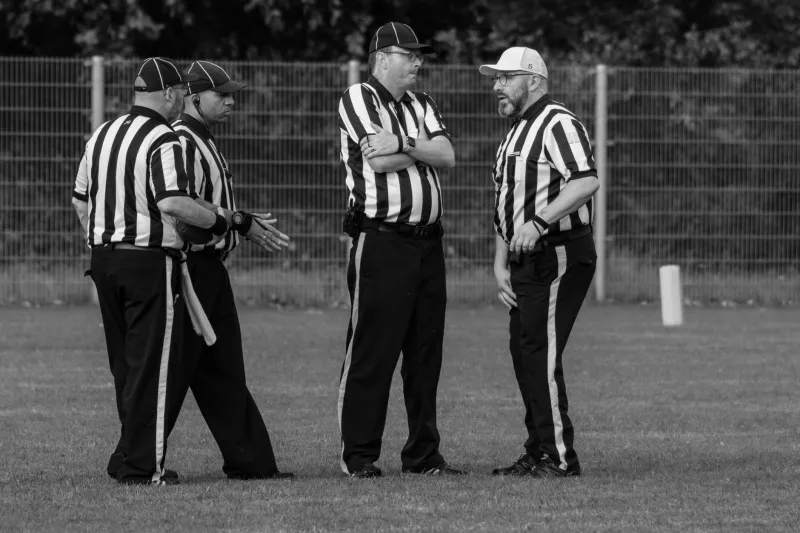
Welcome to the age of replay review, where the most dangerous person in sports betting isn't a sharp, a syndicate, or a sportsbook algorithm. It's a middle-aged official in a booth somewhere in New York squinting at a freeze frame that looks like abstract art.
The Catch That Wasn't (And the Bankroll That Isn't)
The NFL's catch rule has been a philosophical nightmare for so long that it's basically a running joke at this point. What constitutes a "football move"? Does the ball need to survive contact with the ground? Does the receiver need to maintain possession through his soul leaving his body on impact? Nobody knows. The officials don't know. The analysts don't know. Roger Goodell definitely doesn't know.
What we do know is that ambiguity in officiating and live betting exist in a state of perpetual, catastrophic tension. Same-game parlays are built on the assumption that the plays you watch actually count. When a catch gets overturned, it doesn't just change the score — it unwinds yardage totals, resets field position, eliminates a first down, and potentially erases the entire chain of events that was about to cash your ticket.
In 2023, a controversial overturned touchdown reception in a late-season game swung an estimated millions of dollars in live bets within seconds of the reversal announcement. Accounts that were seconds from cashing were suddenly down legs. The sportsbooks barely blinked. They'd already priced in the chaos.
The Slow-Motion Psychological Torture Machine
Here's what makes replay review uniquely devastating for degens: it weaponizes hope.
A bad call that stands immediately is painful, but it's over. You process it, you curse, you move on. But replay review gives you ninety seconds of false optimism followed by a ruling that can go either way. During that window, your brain is already calculating what happens if the call stands. You're mentally spending money you haven't won. You're building a narrative. And then, when the reversal comes, the psychological crash is exponentially worse than if you'd never seen the play at all.
This is not an accident. This is not a flaw in the game. For sportsbooks running live markets, those ninety seconds of review are a golden window. Lines shift. Opportunities emerge. And degens — freshly wounded, emotionally compromised, staring at a parlay that just got gutted — are uniquely susceptible to making the single worst decision available to them.
They panic-hedge.
The Panic Hedge: A Love Story With a Terrible Ending
Panic hedging after a replay reversal is the betting equivalent of texting your ex at 2 a.m. It feels logical in the moment. It is not logical in the moment.
Here's how it plays out: Your parlay had three legs. Two hit. The third was a receiving yards prop for a guy who just had a 40-yard catch overturned, dropping his total below the line. You're down the leg. But there's still time in the game. So you open the live market, find a compensating bet, and try to engineer a recovery. Except the lines have already moved — the books saw the reversal before you finished processing it — and you're now laying juice on a position that's been priced to account for the new reality. You lose the hedge. You've now lost the parlay AND the hedge. You are, as the kids say, cooked.
The numbers on panic hedging after in-game reversals are not published anywhere because sportsbooks have no financial incentive to share them. But every honest bettor who has lived through this sequence knows the outcome. The hedge almost never saves you. It usually just accelerates the damage.
The Booth Is Not Your Friend
There's a tempting conspiracy theory that replay officials are somehow coordinating with sportsbooks to manufacture reversals at maximum financial impact. Let's be clear: that's almost certainly not true, and also not necessary. The system creates the same outcome through pure structural chaos.
College football is even worse, by the way. Conference replay officials operate under slightly different standards, reviews can be initiated by different parties depending on the situation, and the communication to the field can run long enough to completely reset a betting market. College basketball reviews — which have quietly expanded in recent years to include everything from goaltending to out-of-bounds calls — have the same effect in a sport where live betting volume has exploded.
The point is that across every major American sport, the officiating review apparatus has grown faster than any bettor's ability to account for it. You're not just betting on the game anymore. You're betting on the game and the interpretation of the game by a group of humans who disagree with each other roughly 30% of the time on close calls.
How to Not Get Destroyed (Or At Least Get Destroyed More Slowly)
There is no clean solution here, but there are harm-reduction strategies that don't require you to quit betting entirely (which, let's be honest, isn't happening).
Avoid same-game parlays with legs that depend on single contested plays. Receiving yards props, touchdown scorer bets, and anything that hinges on one specific moment are inherently vulnerable to reversal risk. Stack legs that are harder to unwind — team totals, halftime results, game spreads.
Treat the review window as a blackout period. The ninety seconds a play is under review should be a no-bet zone. Nothing you do in that window is rational. Close the app. Put the phone down. Breathe.
Build reversal risk into your parlay construction. If you're building a same-game parlay on a game with a historically flag-heavy officiating crew or a stadium known for contested sideline plays, price that uncertainty into your leg selection. Go shorter. Take less risk on the legs that are most exposure to a single call.
Never hedge from an emotional position. If your first instinct after a reversal is to immediately open the live market and find something to bet, that instinct is wrong. It will always be wrong. The hedge placed in the first five minutes after a reversal is almost never the correct hedge.
The Ref Doesn't Know You Exist
The hardest truth about replay review is the most obvious one: the official in that booth has no idea you have money on the game. He's not thinking about your parlay. He's not thinking about your bankroll. He's looking at a blurry freeze frame and trying to determine whether a receiver's left toe grazed white paint before the rest of his body went out of bounds.
The game doesn't care about your bet. The replay system doesn't care about your bet. The sportsbook, which built its margins to absorb whatever the officials decide, absolutely does not care about your bet.
The only person who cares about your bet is you. Which means the only person who can protect it is also you.
Good luck. You're going to need it. The booth is already reviewing the next one.